Hostel vs Hotel vs Airbnb in 2026: Which Is Worth It for Solo Travelers?
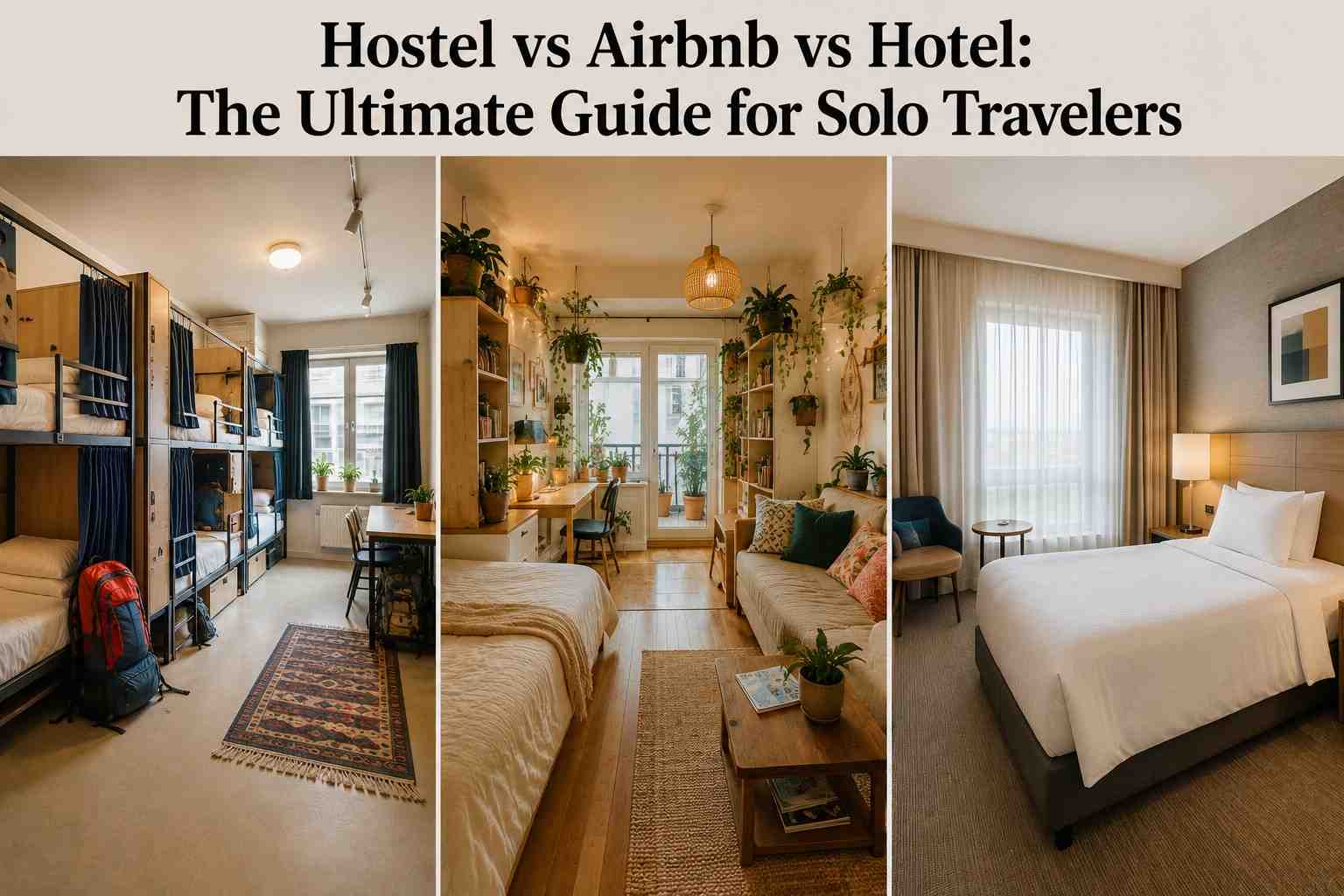
On a single trip you might want all three. A hostel dorm when you want to meet people. An Airbnb when you need a kitchen and some space. A hotel room the night before a 6 AM flight, when sleep matters more than anything. Many travelers pick a side, "always hostels" or "never again," when the better question is what suits this trip, this city and this stage of the journey.
Below, I compare typical prices by region, explain who each option suits, and point out when each one is the clear winner or a poor choice.
Hostels in 2026
The old picture of a hostel, with a grubby dorm, broken lockers and a bathroom nobody cleans, is mostly out of date. In most big backpacker cities, pod-style beds with reading lights, USB chargers, privacy curtains and your own locker are now standard. The top-rated hostels in Bangkok, Lisbon, Chiang Mai, Medellín and Cape Town are nice places to stay, not just cheap ones.
The basic deal hasn't changed, though. You share a room to pay less, and the common areas are set up so guests get talking. If privacy and quiet matter most to you, no amount of nice design fixes that. If you want to meet people and save money, hostels have never been better at both.
What Hostels Cost in 2026
| Destination | Dorm Bed Per Night | Private Room Per Night |
|---|---|---|
| Southeast Asia (Bangkok, Hanoi) | $5 to $12 | $18 to $35 |
| Eastern Europe (Belgrade, Krakow) | $10 to $18 | $30 to $55 |
| Western Europe (Lisbon, Barcelona) | $20 to $40 | $60 to $100 |
| Latin America (Medellín, Buenos Aires) | $12 to $22 | $30 to $60 |
| East Africa (Nairobi, Kampala) | $8 to $18 | $22 to $45 |
Most good hostels now offer both dorm beds and private rooms. A hostel private room is not a hotel room. The bathroom is usually shared, the bed may be a bunk, and soundproofing is minimal. Still, at $30 to $55 a night in cities where budget hotels charge $70 to $120, they're good value if you want a door that locks without paying hotel prices.
When Hostels Win
Hostels suit solo travelers on a budget best, especially those aged roughly 18 to 35. A dorm bed usually costs 40 to 60% less than a budget hotel room nearby. Between the shared kitchen, the common room, the walking tours and day trips many hostels organize, and simply sharing space with other solo travelers, it's easy to make friends. That matters a lot on your first solo trip or a long stretch on the road.
Hostels also tend to be extremely well-located. Their guests walk and use public transport, so they set up in central areas where a hotel room would cost twice as much. Once you factor in location, the savings are even bigger.
When Hostels Lose
Put 8 to 10 people with different body clocks in one room, add phone torches at 2 AM and the odd guest who can't whisper, and many people simply won't sleep. If you have an early start, sleep lightly, or need a quiet night to function, a dorm bed will cost you in energy and enjoyment what it saves you in cash.
For couples the sums change. A hostel private room for two often costs about the same as a budget hotel room, but you get less privacy, a shared bathroom and thinner walls. In that case, take the hotel.
Hotels: What You're Paying For
With a hotel, you're paying for predictability. You get a private room and bathroom, a staffed front desk that can fix problems, regular housekeeping and usually reliable WiFi. The price covers the staff, the cleaning and the upkeep that make every stay much the same.
In many lower-cost countries, a $40 to $80 budget hotel is perfectly fine: a clean room, your own bathroom, a decent bed, working air conditioning and sometimes breakfast. It won't have much personality or a social scene, but it does what it says.
What Hotels Cost in 2026
| Destination | Budget (per night) | Mid-Range (per night) | Comfortable (per night) |
|---|---|---|---|
| Southeast Asia | $20 to $40 | $50 to $90 | $100 to $180 |
| Eastern Europe | $35 to $65 | $70 to $130 | $150 to $280 |
| Western Europe | $70 to $120 | $130 to $220 | $250 to $500 |
| Latin America | $30 to $60 | $65 to $130 | $140 to $300 |
| Middle East (Dubai) | $35 to $75 | $80 to $180 | $200 to $500 |
When Hotels Win
Hotels are the obvious choice if you're traveling for work, have an early flight, need a quiet night, or want someone at the front desk when things go wrong. They also work well for couples and small families, because splitting one room brings the cost per person down to the level of the alternatives or below.
For solo travelers doing shorter trips of 3 to 5 nights in a single city, a well-located budget hotel often makes more sense than the logistics of a hostel. There isn't really time to build the friendships that make a hostel worth it, and the extra cost over four nights is manageable.
Hotels also win on loyalty programs. If you travel regularly, staying at chain hotels builds points that eventually convert to free nights, upgrades, and late checkout. If you take more than four or five trips a year, count those points when you compare prices.
When Hotels Lose
In expensive cities, budget hotels are often the worst deal of the three. For $90 a night in London or Paris you may get a tiny room, a shared bathroom down the corridor and nothing else. An Airbnb at the same price might come with a kitchen and a living room. A hostel dorm gets you a central location, company, and a bill 50 to 60% lower.
Hotels also lose for extended stays. Few budget hotels give much of a discount for longer stays, and without a kitchen you end up eating out for every meal. If you're staying in one place for two weeks or more, an apartment is almost always cheaper and more comfortable.
Airbnb: What It Is and What It Has Become
Airbnb began as a way to rent a spare room in someone's home. Today listings range from a room in a family flat to luxury villas run by management companies, and the experience varies just as widely. Many apartments are now run by companies with dozens of units, and feel more like a hotel without the front desk than a stay with a local.
Fees are still the biggest catch. A $70-a-night listing looks cheap until you add a $60 cleaning fee, service fees and local taxes, and suddenly one night costs well over $150. Airbnb now shows the total price more clearly, but cleaning fees still punish short stays. On a week-long booking, that one-off fee is spread over more nights.
What Airbnb Costs in 2026
For a solo traveler booking a private room (not an entire apartment) in a shared Airbnb listing, the real per-night costs after fees tend to look like this:
| Destination | Listed Nightly Rate | After Cleaning Fee and Service Charge (1 night) | After Fees (7 nights) |
|---|---|---|---|
| Southeast Asia | $25 to $45 | $60 to $100 | $35 to $60 effective |
| Eastern Europe | $40 to $70 | $85 to $130 | $55 to $85 effective |
| Western Europe | $60 to $120 | $120 to $200 | $80 to $140 effective |
| Latin America | $35 to $65 | $75 to $120 | $48 to $80 effective |
For groups renting a whole apartment, it's a different story. Four people sharing a $120-a-night two-bedroom apartment pay $30 each, less than almost any hotel in the same city. Every extra person and every extra night makes Airbnb better value.
When Airbnb Wins
Airbnb is usually the best choice for groups. Once there are three or more of you, a shared apartment nearly always costs less per person than several hotel rooms. It's also good for long stays. Many hosts offer weekly or monthly discounts of 20 to 50%, and a kitchen cuts your food bill a lot over two weeks or more.
Airbnb also wins when you want to feel like a resident rather than a tourist. In a residential neighborhood you shop at the local supermarket, get to know a cafe or two, and settle into a routine that's hard to find in a hotel. If you spend two or three weeks in one city, that changes the whole feel of the trip.
When Airbnb Loses
Airbnb loses for short solo stays, usually anything under 5 nights, where the cleaning fee makes the effective nightly rate worse than a hotel. It also loses when the host is unresponsive, check-in involves a confusing lockbox code in an unfamiliar neighborhood at 11 PM, and the "fully equipped kitchen" is a hot plate and two pots. This happens less often now that Airbnb has tightened its standards, but results still vary more than at a chain hotel, where you know what you're getting.
Cities such as Barcelona, Amsterdam and New York have also clamped down on short-term rentals, and the number of listings has dropped sharply. There, what used to be the cheap option is now scarce, and a listing that looks too cheap may not be legal.
Which One Should You Book?
There's no single best option. It comes down to four things: how many of you are traveling, how long you're staying, what you care about most (price, privacy, meeting people, or living like a local), and what's available in that city.
Solo traveler, 3 to 5 nights, tight budget: a hostel dorm or hostel private room. Over four nights, the savings add up.
Solo traveler, 3 to 5 nights, some flexibility: a budget hotel, for reliability and better sleep. On a short trip, missing the social side matters less.
Solo traveler, 10 to 30 nights in one city: an Airbnb room or small apartment. Weekly discounts and home cooking make it cheaper and more comfortable.
Two people: compare a hotel double room with a small apartment. For stays of more than a few nights, the apartment usually wins on comfort and often on price.
Group of three or four: an apartment, which is usually far cheaper and roomier.
Business travel or a tight schedule: a hotel. When a bad night could wreck your plans, the reliability and front desk support are worth it.
A Combination That Works Well
After years of solo travel, this is what I do: two or three nights in a hostel when I arrive somewhere new, then a budget hotel or Airbnb room for the rest of the stay.
Hostels help most with the loneliest part of a solo trip, those first days when you don't know anyone and nothing is familiar. After a couple of evenings in the common room, you'll usually have a few people to eat or explore with. Once you do, the noise and lack of privacy aren't worth putting up with any more, and a hotel or Airbnb gives you better sleep and more space for not much more money.
It means booking two places instead of one, which is a little more hassle. But you get the best of both without committing to either for the whole trip.
Practical Tips Regardless of Which You Choose
Read the latest reviews, not just the overall score. A hostel rated 9.2 from 800 reviews is a worse bet than one rated 8.6 if its last 20 reviews complain about new management and dirty bathrooms. The most recent 10 to 15 reviews tell you far more about how a place is now than its average.
For hostels, filter by minimum rating of 8.5 on Hostelworld and check the Free Cancellation option so you can change plans if needed.
For hotels, book direct after using Google Hotels to find the best price. Hotels usually keep their public rate the same across booking sites, but many offer lower member rates on their own website. The saving is small per night but adds up over a longer stay.
For Airbnb, calculate the true per-night cost including cleaning fee and service charge before comparing to a hotel. Don't compare nightly rates. Compare the full checkout price for the same number of nights. For stays of a week or longer, message the host first and ask about a weekly rate, because many will offer a discount they don't advertise.
Safety and Security Across All Three Options
Safety is one of the first things solo travelers ask about, especially on a first trip. All three options are generally safe if you choose carefully, and all three can occasionally go wrong.
In hostels, the main security concern is valuables in shared sleeping spaces. Good hostels provide individual lockers that fit a 15-liter daypack, laptop, and phone. Bring your own padlock (most hostels do not supply them), or buy one from reception for a small charge. Lock your valuables when you leave the room and when you sleep. Do not leave laptops or cameras on your bed while you nap. These 30-second habits deal with most of the theft risk. Violent crime in hostels is rare. What really happens is things being taken from unlocked bags.
In hotels, security is handled by the property rather than by you. Your room has a key or key card, typically a safe for valuables, and front desk staff who are responsible for the property's security. The risk is lower than in a dorm, but not zero. Thefts from hotel rooms do happen, if less often than people fear. Use the room safe for your passport and excess cash. Do not leave electronics or wallets on visible surfaces when you leave the room.
Airbnb security varies more than the other two because it depends heavily on the specific property and host. A well-reviewed Airbnb in a residential building with electronic lock entry and a responsive host is as secure as a hotel room. An Airbnb with a physical key hidden under a doormat, questionable door locks, and a host who does not respond to messages is a different situation. Before you book, look for a listing with at least 20 reviews, a host response rate above 90%, and no recent reviews that mention safety or security. Read the newest reviews, not just the rating.
For women traveling alone, the picture is a little different from what many expect. Plenty of solo women say they feel safer in a well-run hostel than in a cheap hotel. There are staff and other guests around at all hours, common areas are well lit, and many hostels offer female-only dorms. Hotels are not automatically the safer choice, so judge each place on its reviews, its location and how it handles security.
The Role of Location in the Comparison
Location changes the real cost of a room more than most people allow for. A budget hotel 40 minutes by taxi from everything isn't cheap once you add daily fares and lost time. A central hostel dorm that costs more per night than an outer-suburb hotel can work out cheaper for the whole trip once you count what you save on transport.
Hostels tend to be well placed because their guests walk and use public transport. A hostel in a bad location doesn't get bookings, so most are in walkable central areas. In Barcelona's Barrio Gotico, Lisbon's Bairro Alto, and Bangkok's Silom area, the best-rated hostels are within walking distance of the things that draw travelers to those neighborhoods. Any extra cost per night is often fully covered by what you save on transport.
Hotels vary enormously by location. Chain hotels in airport areas or business districts are convenient for specific purposes but poor bases for tourism. Budget hotels in tourist neighborhoods are well-located but priced accordingly. The sweet spot is often a stop or two outside the tourist center, where prices fall but transport links stay good.
Airbnbs are the most variable of the three for location because listings span every neighborhood, from city centers to distant suburbs. Always use the map view. Before booking, check how far the listing is from a metro or bus stop, how long the ride is to the areas you want to see, and whether there are shops and places to eat nearby. Twenty minutes by metro from everything is fine. Needing a $15 taxi every time you go out is not.
Booking Platforms: Which to Use for Each Option
The platform you book through affects both what you pay and what recourse you have if something goes wrong.
For hostels, Hostelworld is the dominant platform and has the deepest inventory. Booking.com also lists many hostels. Hostelworld's ratings are built for hostels and cover things like atmosphere, staff and common areas, which Booking.com's general scores don't capture as well. Its reviewers have all stayed there as hostel guests, so for a dorm bed in a new city, a Hostelworld rating is usually the more useful guide.
For hotels, start with Google Hotels to compare prices across sites, find the best rate, then check the hotel's own website for a lower member rate. Booking.com's free cancellation filter is handy if your plans might change. In Southeast and East Asia, Agoda is often cheaper than Booking.com.
For Airbnb, book only through the official Airbnb platform rather than attempting to contact hosts directly off-platform. If you pay outside Airbnb, you lose its guest protection if the listing turns out to be fake or nothing like the photos. The service fee is annoying, but it pays for the support you'll want if something goes wrong. A host who asks you to pay by bank transfer is a warning sign.
A useful note for any platform: the cancellation policy matters as much as the price. Saving $15 a night on a non-refundable rate is a bad deal if your plans might change. On a first trip abroad especially, choose free cancellation until your visa is approved, your flight is booked and your plans are settled.