How to Travel on a Naira Budget in 2026: Exchange Rates, Cheap Destinations, and Making Your Money Work Abroad
In early 2022, the official rate was about 420 naira to the dollar. As of mid-2026 it's around 1,580, depending on where you change money. Most of that fall came between mid-2023 and early 2025. At the official rate, anything priced in dollars now costs nearly four times as many naira, even though hotels, flights and food abroad cost about the same in their own currencies.
Take a week on the ground in Bangkok costing about $800. At the 2022 official rate that was roughly 336,000 naira. Today it's around 1.26 million naira. Prices in Bangkok barely moved. The naira did.
That's the reality of traveling from Nigeria in 2026, and most travel guides, written for people with stronger currencies, never mention it. This one starts from naira and works out what a real trip costs on a Nigerian budget.
The Exchange Rate Reality in 2026
In mid-2026, the official rate was around 1,560 to 1,580 naira to the dollar. Bureau de change rates were close to that, a big change from 2023 and 2024, when the gap between official and street rates was huge.
For planning, the tables below use 1,580 naira to the dollar. Always check the rate on the day you plan and again before you pay. Roughly:
| Foreign Currency | Approximate Naira Cost |
|---|---|
| 1 US Dollar (USD) | N1,580 |
| 1 Euro (EUR) | N1,730 |
| 1 British Pound (GBP) | N2,010 |
| 1 UAE Dirham (AED) | N430 |
| 1 Thai Baht (THB) | N44 |
| 1 Kenyan Shilling (KES) | N12 |
| 1 Turkish Lira (TRY) | N38 |
| 1 Malaysian Ringgit (MYR) | N365 |
These rates move every day, and the lira in particular keeps falling, so update your figures when you're ready to book.
In practice: a hostel dorm in Bangkok at 350 baht a night is about 15,400 naira. A guesthouse room in Nairobi at 3,500 Kenyan shillings is about 42,000 naira. A quick lunch in Istanbul at 200 lira is about 7,600 naira. Doing these sums before you go saves you the shock of watching your balance drop faster than expected.
How to Move Your Money Abroad
Nigerian travelers ask me this more than anything else. Each option has different costs, reliability and limits.
Domiciliary Account with International Debit Card
The most dependable way to carry larger amounts. Open a dollar or euro domiciliary account with a bank such as GTBank, Zenith, Access, First Bank or UBA, fund it before you travel, and ask for the linked international debit card. It should work at ATMs and card machines abroad. Confirm this with your bank before you rely on it.
The tricky part is funding it. Buying foreign currency through official channels needs paperwork and can take a few days, so set up and fund the account two or three weeks before your trip, not the week before.
ATM withdrawal fees abroad vary by country but typically run $2 to $5 per transaction. Withdraw larger amounts less frequently rather than small amounts daily to minimize cumulative fees.
Fintech Dollar Cards
Several Nigerian fintech apps let you convert naira to dollars and spend with a dollar card, often virtual. They're convenient for booking flights and hotels online and for some card payments abroad. But many virtual cards can't be used at ATMs, some are declined by certain merchants, and fees and monthly limits differ a lot between apps. Test the card with a small payment before your trip and never make it your only way to pay.
International services such as Wise and Revolut are popular elsewhere, but they don't currently open accounts for people living in Nigeria, so ignore advice that tells you to fund them from a Nigerian bank account.
Cash in Foreign Currency
Always carry some cash regardless of what cards you have. Markets, local transport, small guesthouses, and border crossings often do not accept cards. A reasonable cash float is enough to cover two days of expenses in your destination.
For sourcing the cash in Nigeria, compare rates between your bank and licensed bureau de change operators. The gap between them changes, but even 10 to 30 naira per dollar adds up to 5,000 to 15,000 naira on $500. Only use licensed operators, and check how much cash you're allowed to carry out of Nigeria and into your destination without declaring it.
The Card That Does Not Work Abroad
A standard naira debit card (Verve, most Mastercard and Visa naira cards) is not reliable for international use. Transactions are frequently declined, limits are restrictive, and the exchange rate applied when they do work is often unfavorable. Don't rely on a naira card as your main or only way to pay abroad. Use a funded domiciliary card as your main method, with cash and a tested backup card.
The Best Destinations for a Naira Budget in 2026
Some trips cost far less in naira than others. It depends on prices on the ground, how easy the visa is and what flights from Nigeria cost. These are the places where your naira goes furthest in 2026.
Southeast Asia: Still the Best Value on Earth
Vietnam, Thailand, Indonesia and Malaysia give you some of the most for your money anywhere, and they're still great value even with the weaker naira.
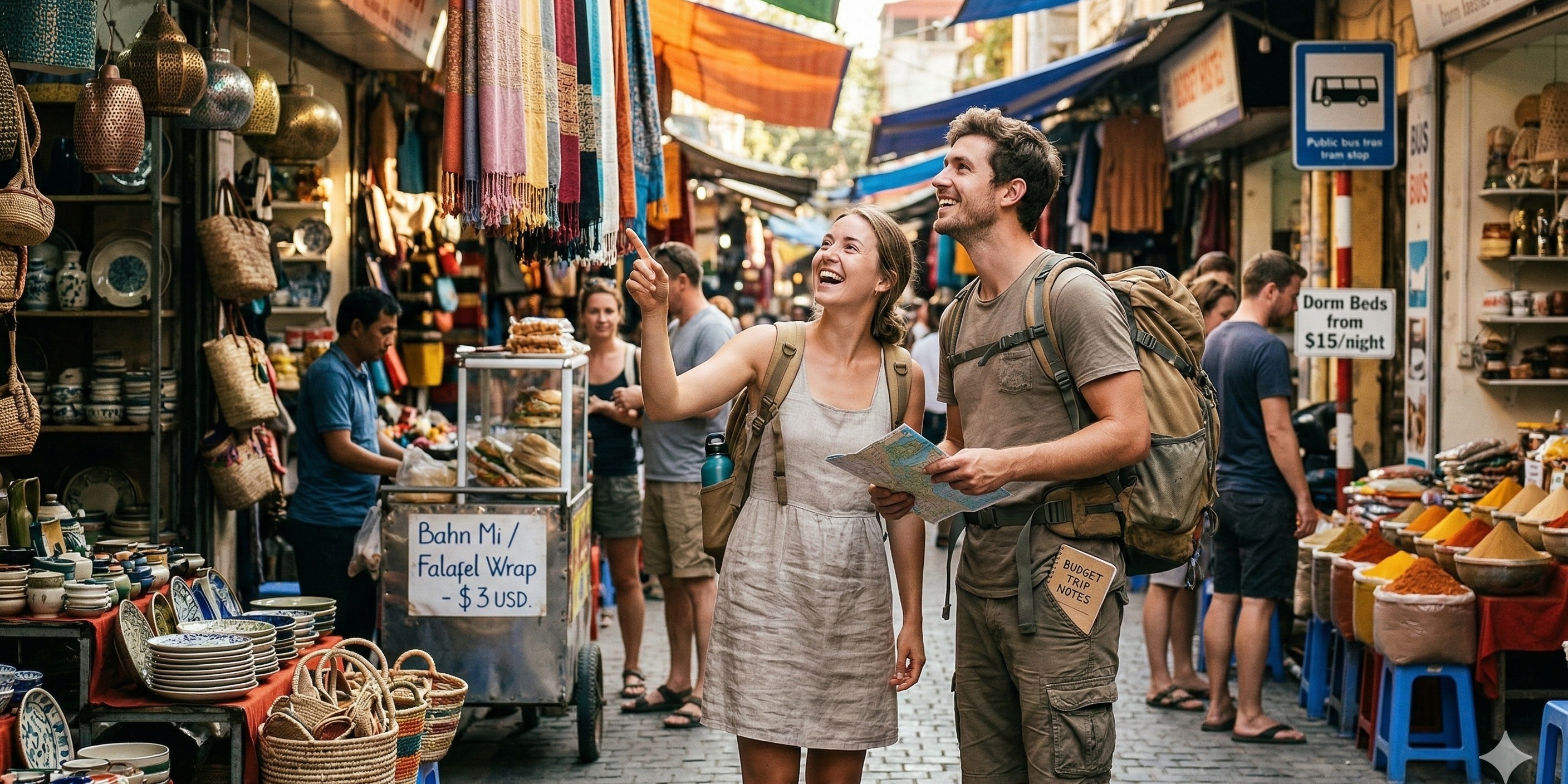
In Vietnam, a guesthouse private room in Hanoi or Ho Chi Minh City costs $12 to $22 per night, which is 19,000 to 35,000 naira. A bowl of pho from a street stall is $1.50, about 2,370 naira. A full day including accommodation, three meals, and local transport runs $28 to $40, which is 44,000 to 63,000 naira. A comfortable week in Vietnam, not counting flights, costs about 310,000 to 440,000 naira.
On a budget, Thailand costs a little more than Vietnam, but not much. Bangkok guesthouses on the Skytrain run $18 to $30 per night (28,000 to 47,000 naira). Street food meals run $1.50 to $3 (2,370 to 4,740 naira). A week in Bangkok on the ground runs 385,000 to 550,000 naira.
Visas: Vietnam's e-visa costs $25 and is straightforward for Nigerians. Thailand and Malaysia both require Nigerians to apply for an e-visa in advance. Indonesia (including Bali) also needs an e-visa arranged before you fly.
Turkey: Good Value if You Can Get the Visa
The Turkish lira has lost a lot of value against the dollar, so Istanbul can be good value even in naira. Getting in is the hard part for Nigerians. You'll normally need a sticker visa through the Turkish embassy's visa center, unless you already hold a valid Schengen, US, UK or Irish visa or residence permit, which may make you eligible for Turkey's much quicker conditional e-visa.
A guesthouse in Istanbul's Sultanahmet or Beyoglu neighborhoods runs $20 to $40 per night (31,600 to 63,200 naira). A full meal at a lokanta, a simple local restaurant, costs roughly $5 to $9 (about 7,900 to 14,200 naira). A week on the ground in Istanbul runs about $300 to $500 (474,000 to 790,000 naira), which is very good for a city with this much history and food.
Check the Turkish embassy website for the current visa fee, documents and processing times before you book flights. If you qualify for the conditional e-visa, apply only on the official site, evisa.gov.tr.
East Africa: Closer, Easier Than You Think
Kenya, Rwanda, Tanzania and Uganda are all within about 5 to 6 hours of Lagos by air, far closer than Asia, and entry for Nigerians ranges from visa-free to a simple e-visa. They aren't the cheapest places day to day, but the shorter, cheaper flights help your total budget.
Nairobi costs $40 to $70 per day for a mid-range budget. Kampala is slightly cheaper. Kigali costs more, but it's clean, safe and well run. Safaris in Kenya and Tanzania (the Maasai Mara and the Serengeti) are expensive, so budget for them separately, because park fees and tours add a lot.
Entry: since 2025, Nigerians can visit Kenya without a visa or eTA for up to 60 days. Rwanda offers Nigerians a 30-day visa on arrival, Uganda uses an e-visa, and Tanzania requires a visa arranged in advance. Kenya Airways flies nonstop from Lagos to Nairobi, and round trips often cost $350 to $550 depending on the season.
West Africa: The Overlooked Option
Ghana, Senegal, Ivory Coast, and other ECOWAS countries offer visa-free entry for Nigerian passport holders and flight times of under 3 hours from Lagos. Because they're so close, people don't always think of them as "going abroad," but they're real trips at the lowest flight prices you'll find.
Accra is worth at least a long weekend. The beaches at Kokrobite and Busua, the history at Cape Coast Castle, the food and the bustle of Makola Market are all worth the hour-long flight. Round trips from Lagos can cost as little as $120 to $200, and day-to-day costs are similar to Nigeria's.
The Gulf: Dubai and Abu Dhabi
Dubai needs a visa, usually $130 to $160 through an agency, but flights from Lagos are competitive on Emirates and on one-stop airlines such as Ethiopian and EgyptAir. If you stay in Deira and eat in local restaurants, daily costs are lower than Dubai's reputation suggests. With careful planning, a budget week including flights and your room is possible for roughly 2 million naira, depending on fares and the exchange rate.
How to Calculate Your Real Trip Cost
Most trip budgets have four parts. Work them out before you book so you don't come home with less money than you planned.
Flight: Return flight price from Lagos (or Abuja) to your destination. This is fixed once you book. Compare on Google Flights, try different dates with the date grid, and book about 10 to 14 weeks ahead, or earlier for December.
Visa: Visa fee plus any service charges and required insurance. Varies by destination from zero (visa-free) to $200+ for complex applications.
Ground costs: Your daily budget multiplied by the number of days. This is where destination choice makes the biggest difference. $50 per day in Southeast Asia gets you a private room, three meals, and local transport. $50 per day in London gets you almost nothing.
Travel insurance: $20 to $60 for a week, depending on where you go and the cover. Don't skip it.
A worked example for a 7-day trip to Bangkok from Lagos in 2026:
| Item | USD | Naira Equivalent |
|---|---|---|
| Return flight (Lagos to Bangkok via Ethiopia) | $520 | N821,600 |
| Thailand e-visa (approx.) | $40 | N63,200 |
| Ground costs (7 days at $50/day) | $350 | N553,000 |
| Travel insurance | $35 | N55,300 |
| Total | $945 | N1,493,100 |
That's about 1.5 million naira for a week in Bangkok. It isn't cheap in naira, but you get a lot for it. In London, the same money might cover three or four nights.
Ways to Cut the Cost
Pick places with cheaper flights from Nigeria. The flight is usually your biggest single cost. Accra, Nairobi, Dubai and Istanbul all have competitive fares from Lagos. Paris or New York may appeal more, but the flight alone can cost $650 to $1,500.
Travel outside peak season. Avoid December and the Easter and Sallah holidays for flights from Nigeria, and check when your destination's busy season is. Shoulder months usually mean lower prices, good weather and fewer crowds.
Stay near where locals live. The main tourist area is almost always the most expensive place to sleep. A metro stop or 15-minute walk away, similar rooms can cost 30 to 50% less. Just check the travel time to the places you want to see. If you can get everywhere in under 20 minutes, that's close enough.
Eat where working people eat at lunch. Every country has a lunch culture aimed at local workers. It is the best food at the lowest price available in any given city. Look for set lunches and food courts in residential areas. Follow people in work clothes rather than tourists and you'll eat better for less.
Change money in the right place. Airport exchange counters usually give the worst rates. Licensed bureaux de change in town do better. Sort most of your money out in Nigeria before you leave, and change only a little at the airport if you must.
Book everything in advance for expensive activities. Many big attractions cost less, or are only available, when you book online ahead. The Burj Khalifa viewing deck charges more for same-day tickets, and timed slots for places like the Colosseum in Rome sell out weeks ahead.
What the Numbers Mean for Your Planning
Here's what travel from Nigeria costs in 2026. At current rates, a budget week in Southeast Asia costs roughly 1.3 to 1.7 million naira all in (flights, rooms, food, transport, visa and insurance). A week in Europe costs about 2.5 to 4 million naira, and a week in North America about 3.5 to 5 million.
These numbers are not out of reach for many middle-class Nigerians who plan deliberately, save up for a trip, and choose destinations that match their budget. They're hard to manage on a whim from a monthly salary. The Nigerians I know who travel regularly plan three to six months ahead, save for each trip on purpose, and pick places that give them the most for every naira.
You can't control the exchange rate. But treat a trip as a savings goal rather than an impulse, and the numbers can work.
Sourcing Foreign Currency in Nigeria: A Practical Guide
In Nigeria, you can't always walk into a bank and ask for dollars. Official channels have limits, unlicensed street dealers carry real risk of fraud and fake notes, and you need to know which bureaux de change to trust. Here's how it works in practice.
Your bank is the most straightforward option if you have a domiciliary account. You can request funding in dollars, euros, or pounds through your domiciliary account and receive a card that works internationally. Banks use rates close to the official rate, around 1,560 to 1,580 naira to the dollar in mid-2026. Many banks also cap how much you can buy or spend abroad each month, and the limits vary by bank and account type, so ask your bank for its current limits well before you travel.
Bureau de change operators licensed by the CBN offer competitive rates and are the right option for cash purchases. The difference between a bank rate and a bureau de change rate on $500 can be 5,000 to 20,000 naira depending on current market conditions. In Victoria Island, Lekki, and Wuse II in Abuja, there are clusters of licensed bureaus where you can compare rates between operators before exchanging. Ask for the selling rate (what they charge you for dollars), compare two or three operators, and only deal with one that displays its CBN license. Count and check the notes before you leave the counter.
Before you rely on any card, call your bank or check its app to confirm three things: that international transactions are switched on, what your daily and monthly limits are, and what fees you'll pay for foreign ATM withdrawals and card payments. Setting this up in advance saves you from a declined card at a hotel desk abroad.
For the trip itself, a sensible split is 60 to 70% on your domiciliary debit card, 20 to 25% as local cash from an ATM or exchange once you arrive, and 10 to 15% in clean, recent US dollar notes kept separately as an emergency reserve.
Flight Costs from Nigeria in 2026
The flight is usually the biggest cost of any trip abroad from Nigeria, and fares on the same route vary a lot. Knowing which routes are good value should shape where you go as much as daily costs do.
These are approximate round-trip prices from Lagos (LOS) for 2026, booked a couple of months ahead outside peak season. Treat them as a guide only:
| Destination | Route | Approximate Round Trip (USD) | Approximate Naira Cost |
|---|---|---|---|
| Accra, Ghana | LOS to ACC direct | $120 to $200 | N189,600 to N316,000 |
| Nairobi, Kenya | LOS to NBO (direct or 1 stop) | $350 to $550 | N553,000 to N869,000 |
| Dubai, UAE | LOS to DXB direct or 1 stop | $380 to $650 | N600,000 to N1,027,000 |
| Istanbul, Turkey | LOS to IST (1 stop) | $450 to $750 | N711,000 to N1,185,000 |
| Bangkok, Thailand | LOS to BKK (1 stop) | $450 to $700 | N711,000 to N1,106,000 |
| Kuala Lumpur, Malaysia | LOS to KUL (1 stop) | $480 to $720 | N758,000 to N1,138,000 |
| London, UK | LOS to LHR direct or 1 stop | $700 to $1,200 | N1,106,000 to N1,896,000 |
| Paris, France | LOS to CDG (1 stop) | $650 to $1,100 | N1,027,000 to N1,738,000 |
| New York, USA | LOS to JFK (1 stop) | $900 to $1,500 | N1,422,000 to N2,370,000 |
The lesson: flights to Southeast Asia and the Middle East can cost about the same as flights to Europe, but daily costs are far lower. A week in Bangkok or Istanbul often costs less in total than a week in London, because you spend 40 to 60% less on the ground.
Ethiopian Airlines is often one of the cheapest options to Asia, and Turkish Airlines is often competitive to Europe. Emirates and Qatar Airways have good connections through Dubai and Doha but aren't always the cheapest. For East Africa, look at Kenya Airways, Ethiopian and RwandAir. For West Africa, Air Peace, ASKY and Africa World Airlines are among the airlines flying regional routes.
Timing Your Trip to Stretch the Naira Further
The same trip can cost very different amounts depending on when you go. Daily costs in shoulder season can be 25 to 40% lower than in peak season, and with cheaper flights on top, a well-timed trip can cost a third to half less.
For Southeast Asia, the cheapest travel months are April through June and September through October. April is very hot in Thailand and Vietnam, but prices fall. October brings some rain to Thailand and to central Vietnam, but it's still a good-value month. The expensive months are December to February, with dry weather and the highest prices, and July and August, when European summer holidays push up prices at tourist hotels.
For Turkey, March through May and September through November offer good weather and prices that are 20 to 35% below peak summer rates. Istanbul in October is excellent: fewer tourists, comfortable temperatures, and hotels at reasonable prices.
For East Africa, the dry seasons (June through October and January through February) are the peak wildlife seasons and the most expensive times to visit Kenya and Tanzania. March through May sees heavy rain and much lower prices. If your trip is about cities, food, and culture rather than safari, March through May is a reasonable time to go and saves money.
The simple rule: for any destination, compare shoulder season prices with peak season. For a week-long trip the difference is often 300,000 to 600,000 naira.
What a Day Costs on the Ground
Daily budgets are useful for planning, but it helps to see where the money goes. Here's a typical day in three places popular with Nigerian travelers, converted to naira at mid-2026 rates.
A day in Bangkok (budget): Hostel dorm bed 350 baht (N15,400). Rice porridge (jok) for breakfast from a street stall 50 baht (N2,200). MRT to Sanam Chai station for Wat Pho 45 baht (N1,980). Wat Pho entry 300 baht (N13,200). Pad kra pao with rice for lunch 60 baht (N2,640). Grab motorbike ride across town 55 baht (N2,420). Som tam and grilled chicken for dinner 120 baht (N5,280). Thai iced tea from a street cart 40 baht (N1,760). Total: roughly N45,000, not counting your flight.
A day in Istanbul (mid-range): Budget hotel in Beyoglu 700 lira (N26,600). Simit and tea from a street cart 30 lira (N1,140). Tram to Sultanahmet 30 lira (N1,140). Hagia Sophia entry for foreign visitors, €25 or around 1,100 lira (N41,800). Doner kebab lunch 150 lira (N5,700). Ferry across the Bosphorus 30 lira (N1,140). Köfte dinner at a lokanta 250 lira (N9,500). Tea at a tea house 20 lira (N760). Total: roughly N88,000 with the Hagia Sophia, or about N46,000 without it. Lira prices rise quickly, so treat these as rough.
A day in Nairobi (mid-range): Guesthouse in Westlands 5,500 KES (N66,000). Breakfast at a local cafe 600 KES (N7,200). Uber to Karen Blixen Museum 800 KES (N9,600). Museum entry 1,200 KES (N14,400). Nyama choma lunch at a local joint 800 KES (N9,600). Matatu back to the center 100 KES (N1,200). Dinner at a mid-range restaurant 1,500 KES (N18,000). Total: roughly N126,000.
These examples show how much daily costs vary, and that they're manageable once you're there. Bangkok is still one of the cheapest great cities in the world. Istanbul sits in the middle. Nairobi is closer to a Western city in daily costs, but still far cheaper than European capitals.