Europe's Most Underrated Destinations in 2026: 8 Countries Travelers Are Choosing Over Paris and Rome
Europe's postcard cities keep getting busier and pricier, and in peak season the queues can take the shine off. Meanwhile, plenty of other places across the continent have just as much history, food and architecture, at a fraction of the price and with far fewer people. They aren't sleepy backwaters, either. They are working cities where people live their lives, not open-air museums.
The famous cities are starting to push back. Amsterdam has capped the number of tourist overnight stays and limited river cruise ships. Venice charges day-trippers an entry fee on busy days. Barcelona plans to phase out tourist apartment licenses by 2028. As the big names tighten up, more travelers are looking elsewhere, and these eight places are a good place to start.
Why the Classic Destinations Are Struggling in 2026
Paris, Rome and Barcelona are wonderful, and I'm not going to pretend otherwise. But in peak season the crowds can spoil them. Without a timed ticket, the Louvre's queues in July can eat half a morning. Colosseum slots often sell out weeks ahead. And at almost any hour, the Sagrada Familia is ringed by tour groups following raised umbrellas.
Amsterdam has even run campaigns telling certain kinds of visitors to stay away. On Santorini, more than 10,000 cruise passengers have come ashore on a single day, onto an island whose clifftop towns were never built for that many people. Something had to give.
None of this means don't visit those places. If Paris is a dream you've carried for years, go to Paris. But if you're open to the idea that great European experiences aren't limited to a handful of brand-name cities, then these eight destinations will surprise you.
| Destination | Instead Of | Daily Budget | Best Season |
|---|---|---|---|
| Albania | Croatia / Greece | $30 to $55 | June to September |
| Georgia | Turkey / Greece | $30 to $60 | May to October |
| Serbia (Belgrade) | Prague / Vienna | $35 to $65 | April to June, Sept to Nov |
| Lecce, Italy (Puglia) | Rome / Florence | $55 to $90 | May to June, September |
| Ljubljana, Slovenia | Vienna / Prague | $55 to $85 | April to October |
| Timisoara, Romania | Budapest | $30 to $55 | May to September |
| Bilbao, Spain | Barcelona / Madrid | $65 to $100 | April to June, September |
| Ghent, Belgium | Amsterdam / Bruges | $70 to $110 | April to October |
Albania today looks a lot like Croatia did fifteen years ago, and it won't stay this way for long. The Albanian Riviera between Himara and Saranda has turquoise Ionian water, steep cliffs and beaches as good as Dubrovnik's or Mykonos's, for about a third of the price. A decent seaside guesthouse costs $25 to $40 per night in summer. A fresh grilled fish dinner with salad and local wine runs $10 to $15.
For culture, head inland. Berat and Gjirokaster, both on the UNESCO list, are Ottoman-era stone towns built on far older foundations. Berat in particular, with its distinctive whitewashed Ottoman houses climbing a steep hillside above a Byzantine castle, is one of the most visually striking towns I've seen anywhere in Europe. Yet few people outside the Balkans have heard of it.
The caveat: Albania's tourism infrastructure is still developing. Some roads outside the main tourist areas are poor. English is less common outside Tirana and the coastal resorts. If you can roll with delays and don't need everything to run on time, you'll love Albania. If you need things to run like clockwork, give it a couple more years.
Georgia is in our best countries to visit 2026 guide too, and it's worth mentioning again. It sits where Eastern Europe meets Western Asia but doesn't feel like either. The culture, food and language are entirely its own. The wine alone is reason to go. People here have been making it for about 8,000 years, and wine fermented in buried qvevri clay jars comes out amber and tastes nothing like the usual European bottles. A bottle from a cellar in the Kakheti wine region costs $6 to $10.
Tbilisi's old town, with its crumbling Silk Road architecture, sulfur bath houses, and rooftop terraces looking over a tangle of wooden balconies and domed churches, has more atmosphere than almost any old town in Europe or Asia. To the north, the Caucasus has hiking, winter skiing, and landscapes most Europeans don't realize are a few hours' flight away.
Visa rules are generous. Citizens of around 90 countries, including the US, UK and EU, can stay up to a year without a visa, and holders of a valid Schengen visa can usually visit too. Budget flights from Warsaw, Vienna or Istanbul are often under $100 return. For low prices, beauty, easy entry and a culture unlike anywhere else, I think Georgia is the best pick on Europe's edge right now.
When friends ask me for a European city break that won't cost a fortune, I tell them Belgrade. Prague is beautiful, but its old center now feels more like a theme park for visitors than a place where people live. Vienna is wonderful but expensive. Belgrade has history, a strong cafe culture, good architecture and a lively evening scene, at prices that make Western European capitals look silly.
The Serbian capital sits at the confluence of the Sava and Danube rivers, with a hilltop fortress (Kalemegdan) that offers one of the best views of any European city and costs nothing to visit. The Savamala arts district along the Sava riverbank has transformed former industrial buildings into galleries, bars, and creative spaces. In summer, the river barges known as splavovi, moored along both rivers, turn into restaurants, cafes and music venues that locals love.
A coffee in a Savamala cafe costs around $2. A full dinner at a good Serbian restaurant runs $12 to $20 per person, and a comfortable boutique hotel in the center costs $50 to $80 a night. Serbia isn't in Schengen. Many passport holders get 90 days visa-free, and holders of a valid Schengen, UK or US visa can usually enter too, but check the current rules for your nationality.
This is the pick for anyone who wants Italy's food, architecture, history and light without Roman prices or Florentine crowds. Puglia, the heel of Italy's boot, has all of it. Lecce is often called the "Florence of the South," which sells it short. It isn't a copy of anywhere up north. It has a character all its own.
The city's Piazza del Duomo, enclosed on three sides by Baroque masterpieces built from the local honey-colored stone, is one of Italy's great squares, and it costs nothing to stand in. A Roman amphitheater sits half-excavated in the middle of town. Rooms cost far less than in Rome or Florence, even in high summer. And the food is some of Italy's best: orecchiette with cime di rapa, burrata made that morning, focaccia barese, and sea urchin on grilled bread.
Extend into the surrounding region and you get the trulli (cone-roofed stone houses) of Alberobello, the white-washed hill town of Ostuni, and long stretches of Adriatic and Ionian coast with clear, warm water and far fewer visitors than the Amalfi Coast. Fly into Bari or Brindisi, which are well served from across Europe by budget airlines such as Ryanair and easyJet.
Ljubljana is one of the loveliest small capitals I've visited in Europe. It's compact and walkable, with a castle on a hill above an old town full of riverside cafes and independent shops. It was named European Green Capital in 2016 and has put a lot of money into walking and cycling routes. Cars are banned from the center, so the old town is unusually calm for a capital.
With about 300,000 people, it feels more like a university town than a capital. Evenings are relaxed and friendly rather than wild. The food has improved a lot in recent years, with young chefs doing modern things with Slovenian ingredients. And Lake Bled, with its clifftop castle and island church, is only about an hour away by bus.
Slovenia is in the Schengen Area, so it slots easily into a wider European trip on a Schengen visa or a visa-free passport. It costs a little more than Serbia or Albania, but a lot less than Vienna for a similar standard of hotel.
Timisoara is one of Romania's largest cities, yet few international tourists make it there. It was a European Capital of Culture in 2023, and the restored buildings, arts venues and events from that year have outlasted it. Budapest gets the city-break crowds because it's better known, but Timisoara offers Austro-Hungarian architecture, busy cafes and a lively arts scene at much lower prices.
Its two main squares, Piata Victoriei and Piata Unirii, are lined with baroque and Art Nouveau buildings. The city also played a big part in modern history. The 1989 Romanian Revolution, which brought down Ceausescu, began here. You feel that history in Timisoara in a way the more polished tourist story in Budapest rarely gives you.
Flights from Western European hubs are regularly available for under $80 round-trip on Wizz Air and Ryanair. Daily costs are among the lowest on this list, and the cafes and restaurants are excellent for the price.
Few European cities have reinvented themselves as completely as Bilbao. In the 1980s it was a struggling, polluted industrial port. Then Frank Gehry's Guggenheim Museum opened in 1997, and within a decade Bilbao had become a textbook case of urban renewal. Still, the best reason to go in 2026 isn't the Guggenheim. It's the food.
The Basque Country is famous for its cooking, and nearby San Sebastián, about an hour and a quarter away by bus, has one of the highest numbers of Michelin stars per head of any city in the world. You can eat very well at any budget. Pintxos, the Basque take on tapas, cost $2 to $4 each in the bars of Bilbao's Casco Viejo. Michelin-starred tasting menus usually start above $100, but they're often better value than similar meals in Barcelona or Madrid.
Barcelona is straining under its visitor numbers. Bilbao has the culture, food and architecture, plus easy trips to the dramatic Basque coast, without the crush. Interest in the city is growing quickly, so it's a good time to go.
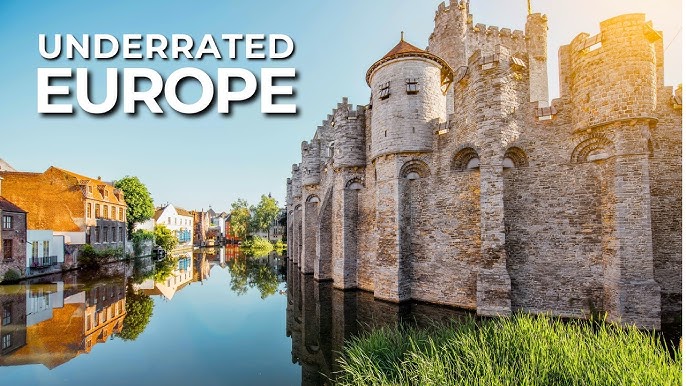
Bruges is exquisite. In summer, though, its lanes are so packed with day-trippers that it can feel like a film set. Amsterdam, as mentioned, is actively trying to cut visitor numbers. Ghent is a good middle ground: a medium-sized Flemish city with medieval canals, waterfront guild houses as handsome as Bruges's, a fine castle (Gravensteen), and far fewer visitors. A big student population keeps the city lively and lived-in, which Bruges no longer manages.
The Ghent Altarpiece by the Van Eyck brothers, considered one of the most important paintings in Western art history, is housed in St. Bavo's Cathedral here. Photos don't do it justice. You need to stand in front of it to take in the size and the astonishing detail. Tickets are timed and cost around $15 to $20, which is fair for what you see.
The students keep the cafes and cheap restaurants busy, and a newer food scene has grown up beyond the Belgian classics. For budget travelers, rooms cost a little less than in Amsterdam, and there are far fewer overpriced tourist traps. Ghent is about 30 minutes by train from Brussels and 25 from Bruges, and from London you can take the Eurostar to Brussels and change there. If you're already in Belgium or the Netherlands, it's an easy addition.
How to Choose
All eight are worth visiting, but they suit different travelers. Here's a quick guide.
If cost is your primary constraint: Albania, Georgia, Serbia, and Romania offer the lowest daily costs. All four can be done comfortably on $35 to $60 per day.
If you want Italian culture without Roman prices: Puglia, especially Lecce and the Salento peninsula around it.
If you're traveling on a Schengen visa: Italy, Spain, Slovenia, Romania and Belgium are all in the Schengen Area. Albania, Serbia and Georgia are not, but all three generally let in holders of a valid Schengen visa (Albania usually asks that it be multiple-entry and already used once). Check the exact conditions for your nationality before you book.
If food matters most: Bilbao and Puglia stand out. The Basque Country in particular is worth planning a whole trip around.
If you want something completely different from Western Europe: Georgia. Nothing else on this list feels quite like it.
Lists like this one help change where people go. Puglia, Bilbao and Ljubljana are already far busier than they were a couple of years ago, so "underrated" doesn't stay true for long. If any of them appeal, go sooner rather than later. Georgia and Albania probably have a few quieter years left. Puglia and Bilbao may be the next Lisbon within a year or two.